



























⮞ Clause 4.1 – Provide accurate and accessible information to prospective and current students

⮞Introduction to Clause 5.1 of the Standards for RTOs 2015

⮞Your Ultimate Guide to Clause 5.2 in VET: Equipping Learners with Informed Decisions

⮞Your Ultimate Guide to Clause 5.3 in VET: Ensuring Transparency in Fee Information for Learners

⮞Your Ultimate Guide to Clause 7.3 in VET: Protecting Fee Payments for Learners

⮞Your Ultimate Guide to Clause 3.5 in VET: Streamlining Credit Transfer for Learners

Introduction to Clause 5.1 of the Standards for RTOs 2015

Clause 5.1 for RTOs under the Standards for RTOs 2015 is essential for ensuring that Registered Training Organisations (RTOs) conduct their enrolment practices ethically and responsibly. This clause plays a crucial role in safeguarding consumer interests and upholding the transparency and trustworthiness of the Vocational Education and Training (VET) sector. It mandates RTOs to engage with prospective learners transparently, assess their suitability, and provide clear and accurate information about training services and outcomes.

Key Requirements of Clause 5.1 Standards for RTOs 2015

The essentials of Clause 5.1 for RTOs include:

Accurate Representation of Course Information

Ensuring all information about courses is reflective of actual offerings.

Accurate Representation of Course Information

Ensuring all information about courses is reflective of actual offerings.

Accurate Representation of Course Information

Ensuring all information about courses is reflective of actual offerings.

Detailed Information Provision

Providing detailed and accurate information about courses, including content, structure, fees, and career pathways.

Transparency in Enrolment for RTO Processes

Disclosing all terms and conditions associated with enrolment clearly and upfront.

Documentation and Record Keeping

Maintaining comprehensive records of the enrolment process.

Suitability Matching

Aligning learner goals with suitable training options to ensure effective learning outcomes.

Use of Clear and Accessible Language

Ensuring that all communications are understandable to the intended audience.

Avoidance of Misleading Claims

Ensuring that no misleading claims are made regarding the outcomes or nature of the training.

Navigating RTO Enrolment Compliance with Clause 5.1

Navigating compliance with Clause 5.1 involves adopting a series of best practices aimed at ensuring the ethical and transparent management of enrolment practices:
  • Regular Review of Enrolment Materials: Regularly checking all enrolment content to ensure it accurately reflects the latest training products, services, and outcomes.
  • Maintain Documentation: Keeping thorough records of all interactions and communications during the enrolment process.
  • Transparency and Honesty: Being transparent and honest in all dealings with prospective learners.
  • Clear Communication of Terms: Clearly outlining any terms and conditions associated with the course and enrolment.
  • Training Product Transparency: Explicitly detailing the outcomes, structure, and requirements of training products.
  • Accurate Assessment: Ensuring the assessment methods used for determining course suitability are fair and effective.
  • Honest Representations: Making only truthful claims about the potential outcomes of the training.
  • Financial Information Clarity: Providing transparent information regarding any fees or financial obligations associated with enrolment.
  • Update Policies and Procedures: Develop clear, documented policies for enrolment and information dissemination. Regularly review these policies to ensure ongoing compliance.

Case Study: Enhancing Transparency and Compliance in Clause 5.1 for RTOs

Background: An RTO based in Sydney revamped its enrolment procedures to better align with Clause 5.1 / Clause 5.1 for RTOs, focusing on improving transparency and learner engagement.

Challenges Identified:

  • Inadequate assessment of learner suitability.
  • Insufficient information provided about course outcomes and prerequisites.
  • Lack of clear communication regarding financial obligations and course fees.

Strategic Solutions Implemented:

  • Comprehensive Enrolment Audit: Conducted a thorough review of all enrolment for RTO materials to ensure accuracy and transparency.
  • Centralised Documentation System: Established a system to maintain updated and accurate course information and records of learner interactions.
  • Implementation of Clear Communication Guidelines: Developed and disseminated guidelines focusing on the clear and honest presentation of course and enrolment information.
  • Dynamic Training Product Updates: Implemented a process for real-time updates to training product information across all communication channels.
  • Transparent Financial Information: Enhanced the presentation of fee information, making it easily accessible and understandable for prospective learners.
  • Outcomes: Following these strategic enhancements, the RTO not only aligned with Clause 5.1 for RTOs requirements but also saw an improvement in learner satisfaction and enrolment rates. The clarity and accuracy of the information led to better-informed decisions by prospective learners.

Interactive Activity: Clause 5.1 RTO Enrolment Compliance Checklist Creation

  • Objective: Create a compliance checklist based on Clause 5.1 requirements to ensure all enrolment for RTO processes are transparent and meet regulatory standards.

Steps:

    1. Review Clause 5.1 Requirements: Revisit the key requirements of Clause 5.1 as outlined above.
    2. Identify Specific Actions: Based on each requirement, identify specific actions your RTO can take to ensure compliance. For example, improving the transparency of enrolment procedures.
    3. Assign Responsibility: For each action, assign a team member who will be responsible for its implementation and ongoing monitoring.
    4. Set Deadlines: Establish realistic deadlines for when each action should be reviewed or completed.
    5. Monitor and Update: Decide on a regular interval for reviewing the checklist’s effectiveness and updating it as necessary.

Implementation Guide for the Activity:

  • Resources Provided: A template for the Clause 5.1 RTO Enrolment Compliance Checklist will be provided to facilitate the creation and maintenance of compliance records.

Common Questions During RTO Enrolment Compliance Audits for Clause 5.1

Transparent and accurate representation means all your enrolment materials should clearly and truthfully describe the training products and services offered, including detailed descriptions of course content, outcomes, prerequisites, and any financial obligations.

Ensure that all aspects of your enrolment process, from initial learner engagement to the finalisation of enrolment, are conducted transparently and responsibly. Regular audits and reviews of enrolment practices can help maintain compliance.

Include comprehensive details about course requirements, accurate information about course outcomes, clear explanations of fees and financial support options, and a transparent overview of the enrolment process.
Implement a robust document management system that ensures all enrolment records are accurate, up-to-date, and readily accessible for review during audits or when needed.
No, guarantees of employment outcomes are not permitted under Clause 5.1. Instead, focus on providing accurate information about the skills and knowledge the course is designed to impart and the types of employment opportunities such training typically supports.

Your Ultimate Guide to Clause 5.2 in VET: Equipping Learners with Informed Decisions

What is Clause 5.2 in VET and Why is it Crucial for RTOs?

Clause 5.2 of the Standards for RTOs 2015 builds upon Clause 5.1 by outlining the minimum information requirements that RTOs must provide to prospective learners before enrolment or training commences. This information empowers learners to make informed decisions about undertaking training with your RTO.

The Actual Requirements of Clause 5.2

Clause 5.2 specifies that information provided by the RTO must include:

Code, Title, and Currency

As listed on the National Register.

Estimated Duration

Realistic timeframe for course completion.

Expected Locations

Where training will be delivered (physical or online).

Expected Modes of Delivery

(e.g., face-to-face, blended, online).

Third-Party Involvement

Details of any external providers involved in training or support.

Your Responsibility

Clearly state your accountability for the quality of training and AQF certification issuance.

Complaints and Appeals Process

Details on how learners can address concerns or appeal decisions.

RTO Closure

Information on procedures if your RTO or a third-party provider ceases operations.

VET FEE-HELP or VET Student Loan

Repayment responsibilities and relevant information.

Course Requirements

Prerequisites, assessments, and expectations for successful completion.

Materials and Equipment

Learner-provided resources required for the course.

Government Subsidy Implications

How government subsidies affect the learner’s experience.

A Step-by-Step Guide to Complying with Clause 5.2 for RTOs

  • Develop a Comprehensive Information Package: This could include a learner handbook, brochure, or website section with all the required information in a clear and accessible format.
  • Integrate Information into Your Enrolment Process: Ensure learners receive the information package before enrolment or training commences.
  • Offer Multiple Information Channels: Provide the information in print, electronically, or through referral to other sources.
  • Train Your Staff: Ensure your enrolment team understands Clause 5.2 and can effectively explain the information to prospective learners.
  • Obtain Learner Acknowledgement: Implement a mechanism for learners to acknowledge they have received and understood the information (e.g., signed declaration).


Real-World Case Study: Best Practices for RTOs Under Clause 5.2

XYZ Training excels at informing learners through a dedicated information pack, interactive presentations, and signed acknowledgement forms. Their commitment to clear and accessible communication ensures learners understand their rights and responsibilities.

Key Takeaways for RTOs: How to Excel in Transparency and Compliance

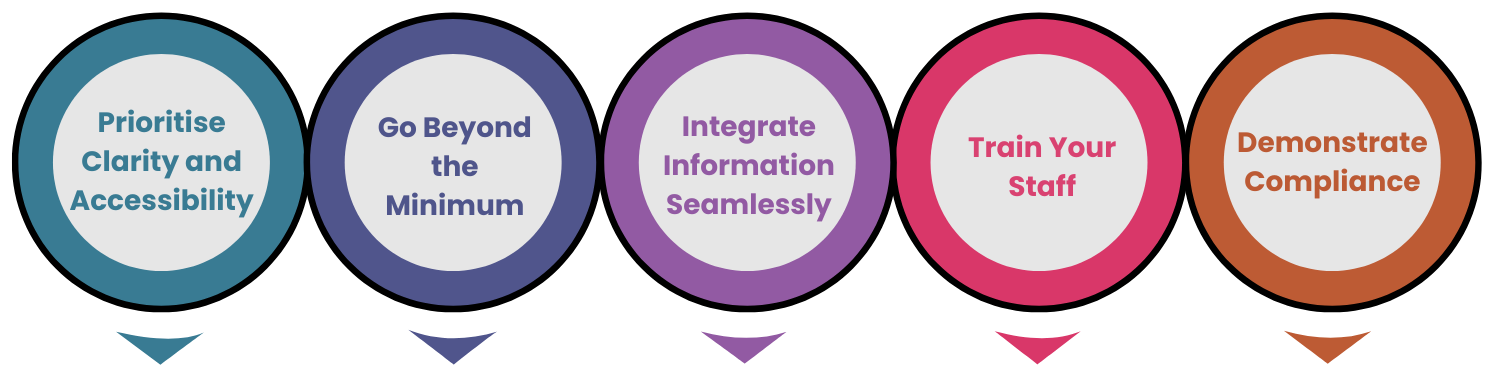
  • Prioritise Clarity and Accessibility: Make information easy to understand and readily available.
  • Go Beyond the Minimum: Provide additional details to build trust and empower learners.
  • Integrate Information Seamlessly: Make it an integral part of your enrolment process.
  • Train Your Staff: Ensure they can effectively communicate the information to learners.
  • Demonstrate Compliance: Maintain accurate records and be prepared to answer questions during audits.

Common Questions Related to Clause 5.2 During Compliance Audits

This question directly assesses your compliance with the core requirement of Clause 5.2.
This type of question assesses if your information formats cater to diverse learner needs and accessibility requirements.
This type of question verifies you effectively inform learners about their rights and responsibilities as per Clause 5.2.
This kind of question evaluates your responsiveness to learner inquiries and your ability to provide clear explanations.
For this kind of question describe your training programs for staff, including content, frequency, and assessment methods related to Clause 5.2.
To answer such questions, explain your review process, including frequency, sources of updates, and how changes are communicated to prospective learners.
Such questions are asked to assess your awareness of potential challenges and proactive measures taken to overcome them.
This verifies auditors, you have robust systems for accurately managing government subsidies and learner repayment responsibilities.

Your Ultimate Guide to Clause 5.3 in VET: Ensuring Transparency in Fee Information for Learners

Common Questions Related to Clause 5.3 During Compliance Audits

This question verifies compliance with Clause 5.3, which mandates clear and upfront fee communication before enrolment.
This question assesses if your fee information caters to diverse learner needs and accessibility requirements.
Describe how you present information on rights and policies (e.g., separate document, website section) and ensure accessibility for all learners.
This kind of question evaluates your responsiveness to learner inquiries and your ability to provide clear explanations.
Auditors may ask these questions to evaluate your responsiveness to learner inquiries and your ability to provide clear explanations about fees.
Auditors may ask this to check if your staff understand and can communicate fee information and policies effectively.
This verifies auditors, you have robust systems for accurately managing government subsidies and learner repayment responsibilities.

What is Clause 5.3 in VET and Why is it Crucial for RTOs?

Clause 5.3 of the Standards for RTOs 2015 focuses on protecting learner rights and promoting financial transparency by ensuring RTOs clearly communicate fee information before enrolment or training starts. This transparency is crucial as it allows prospective learners to make informed financial decisions regarding their education.

The Actual Requirements of Clause 5.3

This clause mandates that RTOs, whether collecting fees directly or through third parties, provide or direct learners to information containing:

  • Total fees payable to the RTO.
  • Payment schedule and timelines.
  • Deposit and refund policies.
  • General consumer rights, including cooling-off periods (if applicable).
  • Arrangement terminates early.
  • The RTO fails to deliver agreed services.

A Step-by-Step Guide to Complying with Clause 5.3 for RTOs

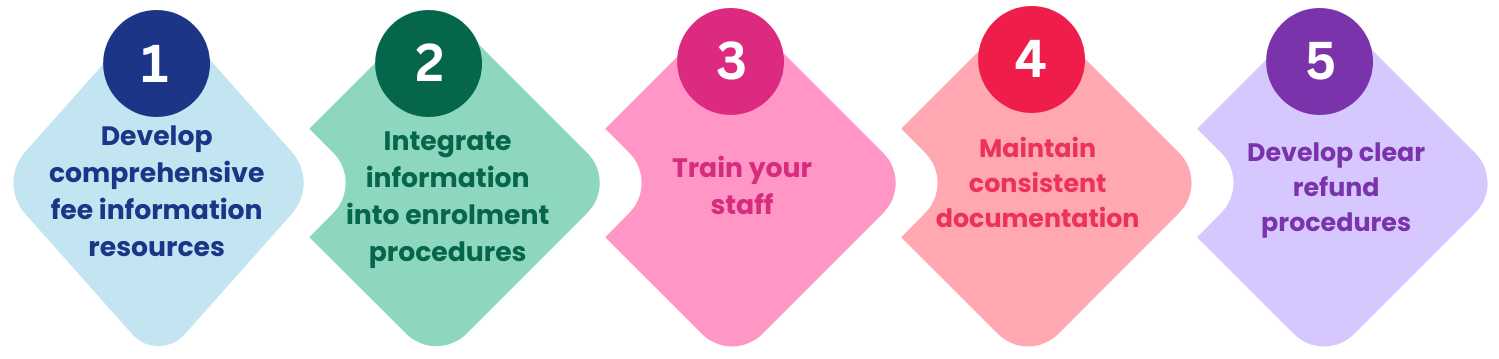
  • Develop comprehensive fee information resources: This could include a dedicated fee schedule, learner handbook section, or website page.
  • Integrate information into enrolment procedures: Ensure prospective learners receive and understand fee information before enrolment or training starts.
  • Train your staff: Equip your team with knowledge of Clause 5.3 and best practices for communicating fee information clearly and effectively.
  • Maintain consistent documentation: Ensure consistency between fee information in various resources and learner agreements.
  • Develop clear refund procedures: Establish fair and transparent policies for issuing refunds in accordance with Clause 5.3

Real-World Case Study: Transparency Matters at Excel Training

Excel Training prioritizes fee clarity with a dedicated guide, outlining all costs, terms, and refund policies. Accessible formats and trained staff empower learners to make informed financial decisions.

Key Takeaways for RTOs: Prioritise Fee Transparency

  • Clear and comprehensive fee communication builds trust and protects learner rights.
  • Invest in accessible and user-friendly information resources.
  • Train staff to effectively communicate fee information and address learner inquiries.
  • Regularly review and update fee information to ensure accuracy and compliance.

Common Questions Related to Clause 5.3 During Compliance Audits

This question verifies compliance with Clause 5.3, which mandates clear and upfront fee communication before enrolment.
This question assesses if your fee information caters to diverse learner needs and accessibility requirements.
Describe how you present information on rights and policies (e.g., separate document, website section) and ensure accessibility for all learners.
This kind of question evaluates your responsiveness to learner inquiries and your ability to provide clear explanations.
Auditors may ask this to check if your staff understand and can communicate fee information and policies effectively.
This question ensures your information stays current and accurate and reflects any changes in fees or policies.
This verifies auditors, you have robust systems for accurately managing government subsidies and learner repayment responsibilities.

Your Ultimate Guide to Clause 7.3 in VET: Protecting Fee Payments for Learners

What is Clause 7.3 in VET and Why is it Crucial for RTOs?

Clause 7.3 of the Standards for RTOs 2015 safeguards learner financial interests by ensuring RTOs implement measures to protect prepaid fees exceeding $1,500. This enrolment ASQA clause arose in response to past incidents where RTOs ceased operations, leaving learners without recourse for their prepaid fees. It empowers RTOs to choose responsible fee structures and protect their reputation by building trust with learners.

The Actual Requirements of Clause 7.3

Limit individual payments to $1,500

This is the most common approach, ensuring no single payment exceeds the threshold.

Obtain an unconditional financial guarantee:

This option requires a bank guarantee covering potential learner refunds.

Join a Tuition Assurance Scheme

This membership protects learners if the RTO fails to deliver training or becomes insolvent.

A Step-by-Step Guide to Complying with Clause 7.3 for RTOs

  • 📊 Assess your fee structure: Identify courses or payment plans exceeding $1,500 in prepaid fees.
  • 🚦 Choose your compliance method:
    • If fees never exceed $1,500 per payment, you don’t need further action.
    • If exceeding $1,500, consider the three options and choose the most suitable one.
  • 🛠️ Implement your chosen method:
    • Option 1: Restructure fee plans to ensure no single payment exceeds $1,500.
    • Option 2: Secure an unconditional financial guarantee from a bank.
    • Option 3: Join a Tuition Assurance Scheme and comply with their requirements.
  • 📁 Maintain compliance documentation: Keep records of fee structures, chosen compliance method, and any relevant agreements (e.g., bank guarantees, scheme memberships).
 

Real-World Case Study: Fee Protection Made Simple at KLM Training

KLM Training demonstrates Clause 7.3 compliance through a structured fee plan. No single payment exceeds the threshold, eliminating the need for additional measures like guarantees or schemes.

Common Questions Related to Clause 7.3 During Compliance Audits

  • Clearly explain your chosen method to enforce the $1,500 limit, ensuring compliance with this key RTO enrolment clause.
  • Assess your understanding and implementation of Clause 7.3 beyond the $1,500 limit to ensure that all financial engagements are secure and transparent.
  • Provide concrete proof of your compliance approach, such as documentation of fee structures, bank guarantees, or proof of Tuition Assurance Scheme membership.
  • Ensure transparency and inform learners about their financial protection under Clause 7.3, integrating clear communication strategies into your enrolment process for RTO.

Your Ultimate Guide to Clause 3.5 in VET: Streamlining Credit Transfer for Learners

What is Clause 3.5 in VET and Why is it Crucial for RTOs?

Clause 3.5 of the Standards for RTOs 2015 promotes national recognition of skills and qualifications by mandating RTOs to accept and provide credit transfer for units of competency achieved elsewhere. This enrolment clause for RTO empowers learners to reduce study time and costs by leveraging their existing skills, fostering smoother transitions within the national training system.

The Actual Requirements of Clause 3.5

AQF Certification Documentation

Issued by any other RTO or authorised issuing organisation.

Authenticated VET Transcripts

Issued by the national Registrar.

Assessment of Equivalency

The RTO must assess if the previously achieved units are equivalent to those offered in their program.

A Step-by-Step Guide to Complying with Clause 3.5 for RTOs

  • 📘 Develop Clear Credit Transfer Policies and Procedures: Outline the process for applying, assessing equivalency, and issuing credit transfers.
  • 📢 Inform Learners About Their Rights: Clearly communicate the opportunity to seek credit transfer in your learner handbook and other materials.
  • 📑 Establish a Streamlined Application Process: Provide user-friendly application forms and a system for efficient processing and communication.
  • 🔍 Implement Robust Equivalency Assessment: Utilise appropriate tools and resources to determine unit equivalence accurately.
  • 🗄️ Maintain Comprehensive Records: Retain all evidence used for granting credit transfers, including documentation of prior achievements and equivalency assessments.

Common Questions Related to Clause 3.5 During Compliance Audits

Our policy supports the requirements of Clause 3.5 by outlining how applications are processed and evaluated, ensuring transparency and fairness in recognising prior learning.
We utilise multiple communication channels including our website, learner handbooks, and orientation sessions to effectively communicate available credit transfer options to learners.”
I can share a case study where we successfully facilitated a credit transfer for a learner, detailing each step from application receipt to the final decision, emphasising our commitment to efficient process management.”
We use a standardised set of criteria and tools designed to ensure that all assessments are conducted fairly and results are consistent with national standards.
Auditors may ask this to check if your staff understand and can communicate fee information and policies effectively.

Request Your Free Sample, Product Info & Pricing Today

By submitting this form, you agree to the VET Resources Privacy Policy.