


Under the Standards for RTOs 2025, Standard 2.1 sets a clear expectation:
👉 Every piece of marketing, enrolment, and student-facing information must be clear, accurate, current, and free from misleading claims.
This includes:
- Your website
- Student handbooks
- Course brochures
- Enrolment forms
- Third-party marketing material (e.g., agents for CRICOS RTOs)

The Standard exists for one reason: to protect students. If they don’t get accurate info before enrolment, they can’t make informed choices about their training and obligations.
What Standard 2.1 Requires
Your RTO must demonstrate:
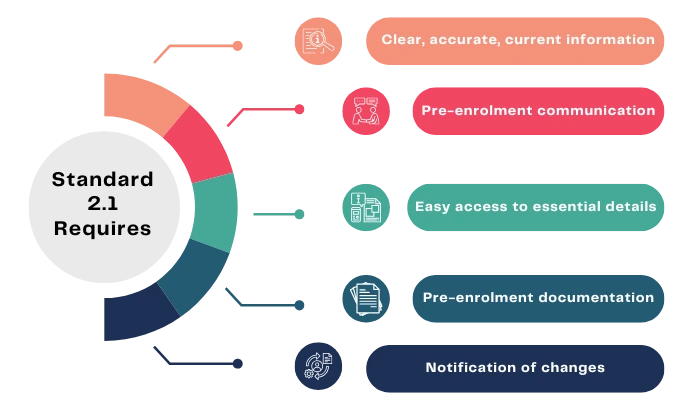
- Clear, accurate, current information
- All published info (internal & third-party) must be reliable.
- Pre-enrolment communication
- Identify what students need to know before enrolment and give it to them before collecting fees.
- Easy access to essential details, including:
- Training product code and title
- Duration, delivery mode, location, commencement dates, scheduling
- Assessment requirements and work placement requirements
- Licensing/occupational licence requirements
- Third-party arrangements
- Support and wellbeing services
- All fees, charges, refund policies, subsidies, payment terms
- Student obligations (equipment, USI, withdrawal process, placements)
- Pre-enrolment documentation
- Written confirmation of:
- Training to be provided (by RTO/third parties)
- All fees and charges
- Student obligations
- Written confirmation of:
- Notification of changes
- Students must be informed as soon as practicable of changes to:
- Training products (superseded/deleted)
- RTO operations (location, delivery mode, third-party changes)
- Students must be informed as soon as practicable of changes to:
Common Non-Compliances (Consultant Insights)
From 15+ years in compliance consulting, I see the same issues repeatedly:
Non-compliant FEDS files
- RTOs list course names but omit the course codes.
- Students can’t verify what they’re enrolling in.
Marketing superseded courses
- Outdated qualifications still on websites or brochures.
- ASQA has issued fines of up to $50,000 for this breach.
Out-of-date documents
- Student handbooks still reference the 2015 Standards.
- Old refund policies linked on the website.
- Policies not updated after Standards 2025 release.
CRICOS agent lists not current
- International student agents missing or outdated on RTO websites.
- Breach of ESOS Act obligations.
Hidden or unclear fees
- Tuition listed, but material/placement/withdrawal fees not disclosed.
- Refund policies not upfront.
Slow or no communication of changes
- Students not informed when qualifications are replaced or deleted.
- No process to notify students of RTO operational changes.
Misleading claims in wording or imagery
- Marketing says “in the heart of Melbourne CBD” when campus is in the suburbs.
- Website shows the Opera House while the RTO is based in Melbourne.
- ASQA now checks images and wording for accuracy.
Case Study – Business RTO Audit
Context:
An RTO offering Certificate IV in Business was audited in 2024.

Findings:
- The website listed old elective units not available on training.gov.au.
- The superseded version of the qualification was still advertised.
- Students paid fees before seeing the full schedules of charges.
- The agent list on the CRICOS page was outdated.
utcome:
- ASQA issued major non-compliance under Standard 2.1.
- RTO had to:
- Update all marketing within 7 days.
- Archive old documents properly.
- Publish a current CRICOS agent list.
- Implement a Marketing & Enrolment Checklist for future compliance.
Result: Rectification accepted, but not before serious reputational damage.
Self-Assurance Checklist
Ask yourself:
- Do all course listings show the code + title from training.gov.au?
- Are website images/wording realistic and location-accurate?
- Have superseded/deleted courses been removed from all materials?
- Are handbooks and student docs updated for Standards 2025?
- For CRICOS: is the agent list current and published?
- Are all fees and refund policies listed upfront?
- Do we notify students promptly about qualification transitions or organisational changes?
FAQs on Standard 2.1
Yes. ASQA has fined RTOs up to $50,000 for marketing superseded courses or misleading information.
Yes. If images create a false impression of location, facilities, or services, ASQA considers this misleading.
- Code & title
- Delivery mode, duration, location, start dates
- Fees, charges, refund policy
- Work placement and equipment requirements
- Contracts must specify compliance responsibility.
- RTO must approve all third-party marketing before publication.
Yes. Students must be informed ASAP when a course is superseded, deleted, or expired.
- Students may receive outdated obligations.
- Auditors will flag this as non-compliance.
- Damages credibility with students and ASQA.
Marketing is your RTO’s first impression. If it’s misleading, outdated, or incomplete, it’s not just a student issue — it’s a compliance and financial risk.
Get Standard 2.1 right, and you’ll protect your students, your registration, and your reputation.