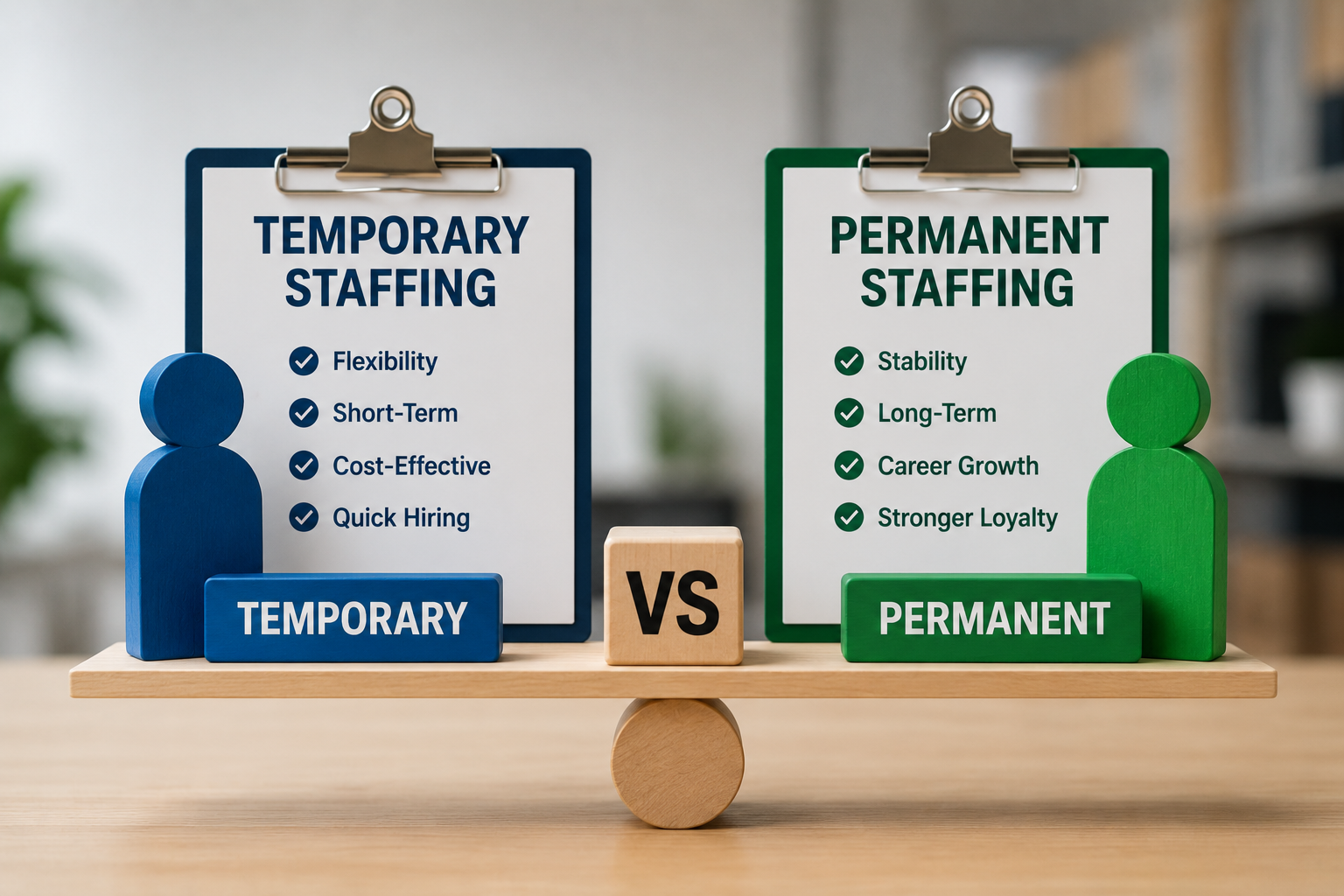
Hiring the right employees is one of the most critical decisions a business can make. However, before starting the recruitment process, companies must first decide what type of workforce they actually need. Should they hire temporary employees for short-term projects, or should they invest in permanent staff for long-term growth?
There is no one-size-fits-all answer. The right staffing model depends on your business goals, budget, workload, and future plans. Some organizations benefit from a flexible temporary workforce that can quickly adapt to seasonal demand, while others require dedicated permanent employees who can contribute to long-term business success.
Understanding the differences between temporary and permanent staffing allows businesses to make informed hiring decisions, reduce recruitment costs, improve productivity, and build stronger teams.
In this guide, we’ll compare both staffing models, discuss their advantages and disadvantages, and help you determine which option is best suited for your organization.
What Is Temporary Staffing?
Temporary staffing refers to hiring employees for a limited period to meet short-term business needs.
These employees may work:
- For a few days
- Several weeks
- A few months
- Until a specific project is completed
Temporary workers are often recruited through staffing agencies that handle recruitment, payroll, and compliance.
Temporary staffing is commonly used for:
- Seasonal business demand
- Special projects
- Employee leave coverage
- Business expansion
- Event management
- Manufacturing
- Warehousing
- Customer support
What Is Permanent Staffing?
Permanent staffing involves hiring employees as full-time members of your organization.
Permanent employees usually receive:
- Fixed salary
- Employee benefits
- Career development opportunities
- Paid leave
- Insurance
- Long-term employment
These employees become an integral part of the company’s culture and contribute toward long-term business objectives.
Permanent staffing is ideal for roles that require consistency, leadership, specialized expertise, and long-term commitment.
Key Differences Between Temporary and Permanent Staffing
| Temporary Staffing | Permanent Staffing |
|---|---|
| Short-term employment | Long-term employment |
| Flexible workforce | Stable workforce |
| Faster hiring process | Longer recruitment process |
| Lower long-term commitment | Higher employee investment |
| Ideal for seasonal work | Ideal for core business operations |
| Staffing agency often manages payroll | Company manages employment directly |
Benefits of Temporary Staffing
Many businesses rely on temporary staffing because it provides flexibility and speed.
1. Faster Hiring
Temporary employees can often be hired within days rather than weeks.
2. Cost-Effective
Businesses save on long-term employment costs, benefits, and onboarding expenses.
3. Workforce Flexibility
Companies can quickly increase or reduce workforce size depending on workload.
4. Project-Based Recruitment
Ideal for businesses handling temporary contracts or special projects.
5. Reduced Administrative Burden
Staffing agencies typically manage payroll, compliance, and documentation.
Challenges of Temporary Staffing
Although temporary staffing offers flexibility, there are some limitations.
These include:
- Higher employee turnover
- Limited company loyalty
- Additional training requirements
- Less organizational knowledge
- Short-term availability
Businesses should carefully evaluate whether temporary workers fit their operational needs.
Benefits of Permanent Staffing
Permanent employees contribute to sustainable business growth.
1. Better Employee Commitment
Permanent employees are generally more invested in company success.
2. Improved Productivity
Long-term employees gain valuable experience and become increasingly efficient.
3. Strong Company Culture
Permanent staff develop stronger relationships with colleagues and customers.
4. Leadership Development
Organizations can nurture future managers and business leaders.
5. Greater Stability
Permanent staffing reduces disruption caused by frequent employee turnover.
Challenges of Permanent Staffing
Permanent recruitment also comes with certain challenges.
These include:
- Longer hiring process
- Higher recruitment costs
- Employee benefits expenses
- Longer onboarding period
- Greater legal responsibilities
Despite these challenges, permanent staffing remains the preferred choice for strategic positions.
When Should You Choose Temporary Staffing?
Temporary staffing works best when your business experiences fluctuating demand.
Examples include:
- Holiday sales periods
- Seasonal manufacturing
- Warehouse operations
- Construction projects
- IT implementation projects
- Marketing campaigns
- Employee maternity leave
- Short-term business expansion
Businesses can quickly respond to changing market conditions without long-term hiring commitments.
When Should You Choose Permanent Staffing?
Permanent recruitment is the right option when hiring for critical business functions.
Choose permanent staffing for:
- Department managers
- HR professionals
- Finance teams
- Sales executives
- Software developers
- Customer relationship managers
- Operations managers
- Senior leadership roles
These positions require long-term knowledge, stability, and career development.
Factors to Consider Before Choosing a Staffing Model
Before deciding, evaluate the following factors.
Business Goals
Are you hiring for long-term growth or a temporary requirement?
Budget
Temporary staffing generally reduces long-term employment costs.
Workload
Seasonal businesses often benefit from temporary employees.
Skill Requirements
Highly specialized positions may require permanent professionals.
Company Growth
Rapidly growing businesses often combine both staffing models.
Can Businesses Use Both Staffing Models?
Absolutely.
Many successful organizations use a hybrid workforce.
For example:
- Permanent employees manage daily operations.
- Temporary workers support seasonal demand.
- Contract professionals handle specialized projects.
- Consultants assist with technical implementation.
Combining staffing models allows businesses to remain flexible while maintaining operational stability.
Why Partner with a Staffing Agency?
Professional staffing agencies simplify recruitment by identifying qualified candidates quickly.
Benefits include:
- Access to pre-screened candidates
- Faster recruitment
- Industry-specific expertise
- Reduced hiring costs
- Compliance support
- Temporary and permanent staffing solutions
Working with experienced recruiters allows businesses to focus on growth while experts handle the hiring process.
Best Practices for Choosing the Right Staffing Solution
To maximize hiring success:
- Clearly define job responsibilities.
- Assess current workforce needs.
- Forecast future business growth.
- Compare recruitment costs.
- Evaluate workforce flexibility.
- Partner with trusted staffing experts.
- Review staffing performance regularly.
A strategic approach helps businesses build an efficient and productive workforce.
Conclusion
Choosing between temporary and permanent staffing depends entirely on your business objectives, operational requirements, and long-term strategy. Temporary staffing provides flexibility, faster hiring, and cost savings for short-term needs, while permanent staffing offers stability, employee loyalty, and long-term business growth.
Many organizations achieve the best results by combining both staffing models, allowing them to adapt to changing market conditions while maintaining a strong core workforce. By carefully evaluating your hiring needs and partnering with a reliable staffing agency, you can build a workforce that supports sustainable success and drives your business forward.
Frequently Asked Questions (FAQs)
1. What is the main difference between temporary and permanent staffing?
Temporary staffing is for short-term business needs, while permanent staffing focuses on long-term employment and organizational growth.
2. Is temporary staffing more cost-effective?
Yes. Temporary staffing can reduce long-term employment costs, benefits, and administrative responsibilities for short-term projects.
3. Which industries commonly use temporary staffing?
Industries such as manufacturing, logistics, retail, healthcare, construction, hospitality, and IT frequently use temporary staffing solutions.
4. Can a company use both temporary and permanent employees?
Yes. Many organizations use a hybrid staffing model to maintain flexibility while ensuring long-term operational stability.
5. Why should businesses work with a staffing agency?
Staffing agencies provide faster recruitment, access to qualified candidates, reduced hiring costs, compliance support, and both temporary and permanent staffing solutions.